The power to establish and regulate and/or operate schools is reserved for what level of government?
President Donald Trump has directed the U.s.a. Department of Teaching to evaluate whether the federal government has "overstepped its legal potency" in the field of teaching. This is not a new issue in American politics.
Ever since the Section of Educational activity became a Cabinet-level bureau in 1979, opposition to federalized education has been a popular rallying weep amidst conservatives. Ronald Reagan advocated to dismantle the section while campaigning for his presidency, and many others since and so have called for more power to be put back into the states' hands when it comes to educational policy. In February of this year, legislation was introduced to eliminate the Section of Educational activity entirely.
So, what is the role of the country versus the federal regime in the world of Grand-12 education?
As a researcher of education policy and politics, I accept seen that people are divided on the role that the federal government should play in K-12 educational activity – a role that has inverse over the course of history.
Growth of public education in states
The 10th Amendment to the United States Constitution states:
"The powers non delegated to the United States by the Constitution, nor prohibited by it to the States, are reserved to the States respectively, or to the people."
This leaves the ability to create schools and a system for didactics in the easily of individual states, rather than the central national regime. Today, all 50 states provide public schooling to their young people – with 50 approaches to pedagogy within the borders of one nation.
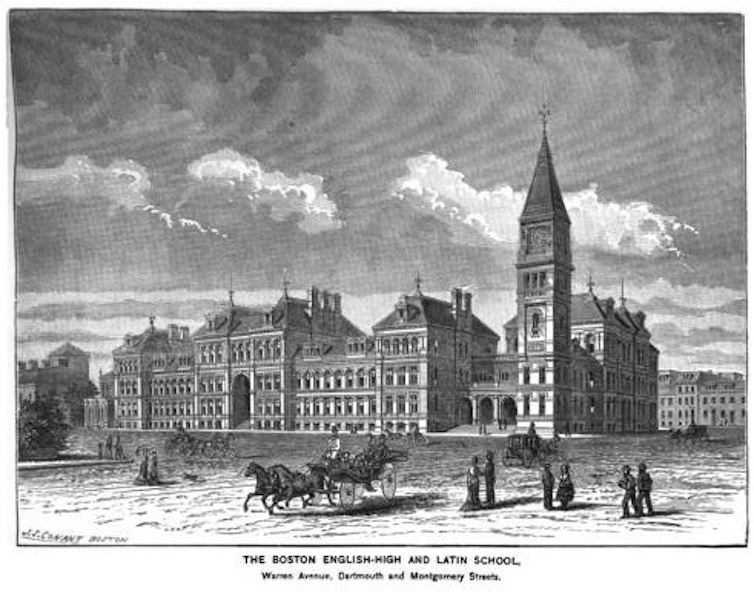
Public schooling on a state level began in 1790, when Pennsylvania became the first state to require free educational activity. This service was extended only to poor families, bold that wealthy people could afford to pay for their own education. New York followed suit in 1805. In 1820, Massachusetts was the first land to have a tuition-costless high school for all, and also the first to require compulsory education.
By the late 1800s, public education had spread to nearly states, in a movement ofttimes referred to as the common school motility. After Globe War I, urban populations swelled, and vocational education and secondary pedagogy became function of the American mural. By 1930, every country had some sort of compulsory education law. This led to increased control of schools past cities and states.
Federal role in teaching
As for the federal authorities'due south role, education is not specifically addressed in the Constitution, merely a historical precedent of central authorities interest does exist.
In 1787, the Continental Congress, the fundamental government of the United States between 1776 and 1787, passed the Northwest Ordinance, which became the governing certificate for Ohio, Illinois, Indiana, Michigan, Wisconsin and part of Minnesota.
The ordinance included a provision encouraging the cosmos of schools every bit a key component of "good authorities and the happiness of mankind." Simply two years earlier, the Land Ordinance of 1785 required land to be reserved in townships for the building of schools.
The role of the federal regime in full general grew much larger after the Neat Low and Globe War 2, but this growth largely excluded K-12 teaching until the 1960s. In 1964, President Lyndon B. Johnson included instruction policy in his vision of a "Great Gild."
Simple and Secondary Education Human activity
In 1965, President Johnson signed the Elementary and Secondary Educational activity Act (ESEA) into police force. This law decidedly changed the role of the federal government in the world of K-12 education.
ESEA doubled the amount of federal expenditures for Thousand-12 teaching, worked to change the relationship betwixt states and the key government in the education loonshit, called for equal handling of students no matter where they reside and attempted to better reading and math competency for children in poverty.
ESEA was passed with the intention of bridging a articulate gap betwixt children in poverty and those from privilege. Title I of the ESEA, which is nonetheless referenced ofttimes in Thou-12 education policy, is a major provision of the bill, which distributed federal funding to districts with depression-income families.
ESEA today
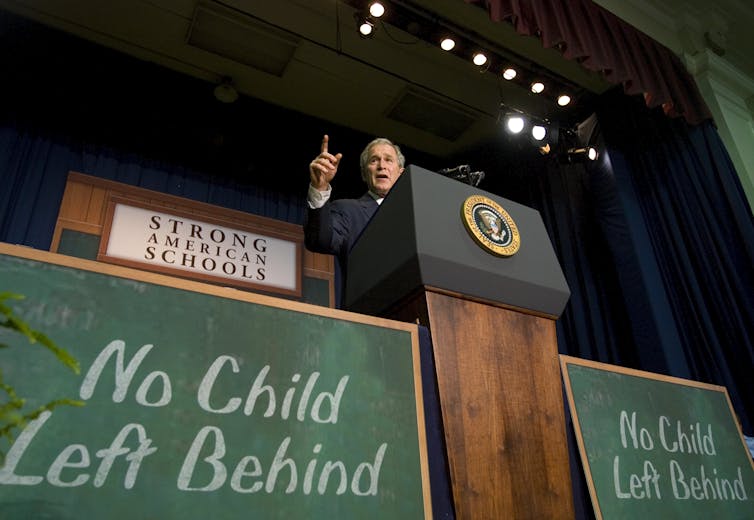
ESEA is still the law of the United States today. However, the police force has required periodic reauthorization, which has led to significant changes since 1965. One of the most well-known reauthorizations was President George West. Bush's No Kid Left Behind (NCLB) Act of 2001. NCLB called for 100 percent proficiency in math and reading scores nationwide by 2014, and expanded the role of standardized testing to measure educatee achievement.
Under President Barack Obama, Race to the Superlative was established, requiring states to compete for federal grants through a signal organisation, which rewarded sure educational policies and achievements. This resulted in nationwide changes in the way teachers are evaluated, and placed even more than emphasis on examination results.
In 2015, Obama signed the Every Student Succeeds Act (ESSA) into law. This is the latest reauthorization of ESEA, and returns some federal power over education back to states, including evaluation measures and teacher quality standards.
The contend continues
Since the 1980s, a growing tendency in the field of Chiliad-12 instruction has been the growth of school choice and charter schools. Every state has its own policy regarding these bug, but during the presidential campaign of 2016, President Trump assured that his administration would provide federal money to assist students attend a schoolhouse of their option. Secretarial assistant of Education Betsy DeVos has dedicated her career to the cause of schoolhouse choice.
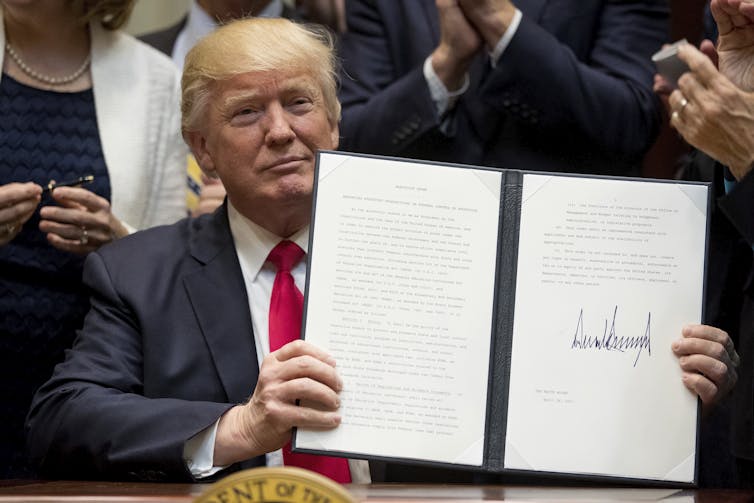
On April 26, President Trump signed the "Education Federalism Executive Club," which requires the United states Department of Didactics to spend 300 days evaluating the office of the federal government in didactics. The purpose of the guild is to "determine where the Federal Government has unlawfully overstepped state and local control." This comes on the back of a proposed thirteen.5 percentage cut to the national didactics upkeep.
It'south not withal known what the results of this study might conclude. But, in my stance, it may affect ESEA and the current funding structure that has been the norm for over 50 years, dramatically impacting funding for students in poverty and with special needs.
Source: https://theconversation.com/federal-role-in-education-has-a-long-history-74807

Post a Comment for "The power to establish and regulate and/or operate schools is reserved for what level of government?"